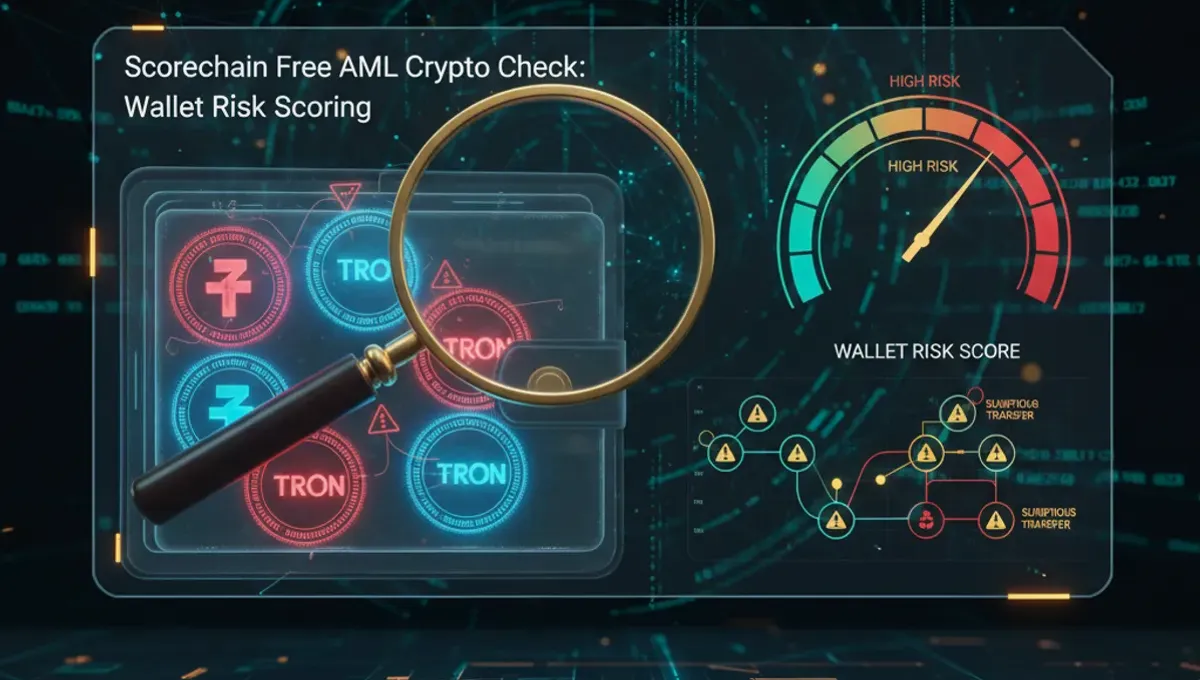
What Is an AML Crypto Wallet Check and Why It Matters
An AML crypto wallet check examines a blockchain address's transaction history and associated entities to calculate risk. The scan flags wallets connected to darknet markets, mixing services, scams, stolen funds, or sanctioned individuals. Exchanges and payment processors use AML checks to comply with financial regulations and avoid processing illicit funds. If you receive USDT or TRX from a flagged wallet, your own account may be frozen or restricted, even if you were unaware of the source. A free AML crypto check before accepting payment is the fastest way to avoid these complications. Risk scoring typically ranges from low (clean transaction history) to critical (direct darknet or mixer connections).
How AML Risk Scoring Works for Crypto Wallets
AML risk scores are calculated by analyzing on-chain transaction patterns, wallet age, fund sources, and connections to known illicit entities. Blockchain analytics platforms maintain databases of addresses linked to darknet markets, ransomware, gambling platforms, and sanctioned entities. When you run an AML check on a wallet, the tool traces incoming and outgoing transactions to identify high-risk paths. A wallet may receive a medium risk score if it has received funds from a mixer, or a critical score if it directly transacted with a known darknet marketplace. Risk levels typically follow this pattern: green (low risk, clean history), yellow (medium risk, some mixer or gambling exposure), orange (high risk, darknet or stolen fund connections), and red (critical, sanctions or major scam involvement). The scoring reflects the wallet's entire on-chain footprint, not just recent activity.
How to Check a Crypto Wallet Before Receiving USDT or TRX
Follow these steps to perform a free AML crypto check on any address:
- Copy the wallet address (TRX, USDT, BTC, or ETH) you want to verify.
- Visit a trusted AML check service—our curated list of verified AML services provides the safest starting point for screening wallets.
- Paste the address into the search field and select the blockchain (Tron, Ethereum, Bitcoin, etc.).
- Review the risk score and transaction summary within seconds.
- Check the detailed report for specific risk factors: mixer exposure, darknet connections, stolen funds, or sanctions flags.
- If the score is green or low-yellow, the wallet is generally safe to transact with.
- If the score is orange or red, contact the sender for clarification or decline the transaction.
Most free AML crypto check tools limit you to a few scans per day, while paid plans offer unlimited checks and API access for businesses.
Understanding Risk Score Levels and What They Mean
Risk scores guide your decision on whether to accept funds from a wallet. Here's what each level typically indicates:
Low Risk (Green): Clean transaction history, no mixer or darknet connections, established wallet age. Safe to receive funds.
Medium Risk (Yellow): Some exposure to mixers, gambling platforms, or unverified exchanges. Acceptable for most use cases, but monitor the account.
High Risk (Orange): Direct connections to darknet markets, mixing services, or stolen fund databases. Proceed with caution; consider declining or investigating further.
Critical Risk (Red): Sanctions list matches, ransomware payments, major scam involvement, or frozen exchange accounts. Do not transact; report to your exchange.
Your exchange or payment processor may have stricter thresholds—some freeze accounts at medium risk, others only at critical. Check your platform's AML policy. When in doubt, an AML check crypto wallet service can provide detailed transaction tracing to help you decide.
What to Do If Your Coins Are Flagged as Tainted
If you receive USDT, TRX, or BTC flagged as tainted or high-risk, take these steps:
- Do not panic. Receiving tainted coins does not automatically make you liable, but holding them may trigger exchange restrictions.
- Run an AML check on the wallet address to understand the specific risk (darknet, mixer, stolen funds, etc.).
- Contact the sender if possible to clarify the source and transaction purpose.
- Notify your exchange before depositing the funds; transparency helps avoid account freezes.
- Consider moving the funds through a compliant exchange that performs its own AML screening, which may "clean" the transaction history.
- Document everything for compliance records in case regulators inquire.
- Avoid mixers or privacy coins as a workaround—this increases regulatory risk and may trigger account bans.
Exchanges freeze accounts when they detect high-risk deposits because they face regulatory penalties for processing illicit funds. A proactive AML check before receiving payment is the best prevention.
Free vs. Paid AML Crypto Check Services
Free AML crypto checks offer basic risk scoring and limited reports, ideal for occasional wallet screening. Most free tools allow 3–10 scans per day and show risk level, transaction count, and major red flags. Paid plans typically cost $10–$50 per month and provide unlimited checks, detailed transaction tracing, API access, and historical reports. Businesses and traders often use paid services for compliance workflows. Our verified AML services page curates trusted platforms that offer both free and paid options, so you can compare features and pricing without testing unreliable tools. When choosing a service, verify it covers your blockchain (Tron, Ethereum, Bitcoin) and updates its darknet and sanctions databases regularly. Free AML crypto check free tools are sufficient for one-off wallet verification; paid services are worth it if you process multiple transactions daily or need audit trails for compliance.
Common Risk Categories: Darknet, Mixers, Scams, and Sanctions
AML checks flag wallets based on specific risk categories:
Darknet Exposure: Wallets that have transacted with known darknet marketplaces or forums. These carry the highest regulatory risk.
Mixer Services: Addresses that have sent or received funds through coin mixers or tumblers designed to obscure transaction trails. Medium-to-high risk depending on mixer reputation.
Stolen Funds: Wallets flagged in theft or ransomware databases. High risk; exchanges typically freeze these immediately.
Gambling Platforms: Some jurisdictions classify gambling as high-risk; others do not. Check your local regulations.
Sanctions Lists: Wallets matching OFAC, EU, or UN sanctions lists. Critical risk; illegal to transact with in most countries.
Scam or Fraud: Addresses associated with Ponzi schemes, rug pulls, or phishing campaigns. High risk.
Unverified Exchanges: Wallets from exchanges without proper AML/KYC procedures. Medium risk depending on exchange reputation.
When you run an AML check on a wallet, the report will specify which categories apply, helping you assess the actual risk rather than relying on the score alone.
Frequently asked questions
Is there a free AML crypto check for USDT and TRX addresses?
Yes. Most AML check services offer free scans with limits (typically 3–10 per day). You can verify a USDT or TRX address instantly by pasting it into a free tool and viewing the risk score. Paid plans unlock unlimited checks and detailed reports. Our verified AML services page lists trusted free options to start with.
What happens if I receive USDT from a wallet with a high AML risk score?
Your exchange may freeze your account or restrict withdrawals if you deposit high-risk USDT. Contact your exchange before depositing to disclose the source. If the risk is due to mixer exposure or unverified origin, the exchange may require additional documentation. Avoid depositing critical-risk funds; they may be permanently blocked.
How long does an AML crypto wallet check take?
Most AML checks complete in 1–5 seconds. The tool queries blockchain data and cross-references sanctions and darknet databases instantly. Some detailed reports with full transaction tracing may take 10–30 seconds. Real-time speed is one reason free AML crypto checks are practical for pre-transaction verification.
Can an AML check identify stolen crypto or ransomware payments?
Yes. AML checks cross-reference wallets against theft and ransomware databases maintained by blockchain analytics firms. If a wallet received funds from a known ransomware attack or theft, it will be flagged as high or critical risk. This helps you avoid receiving stolen funds that exchanges will freeze.
What's the difference between an AML check and a KYC check?
An AML check analyzes a wallet's transaction history and on-chain risk. A KYC check verifies the identity of the person behind the wallet (name, address, ID). AML checks are blockchain-based and instant; KYC requires personal documentation and manual review. Both are used by exchanges for compliance.