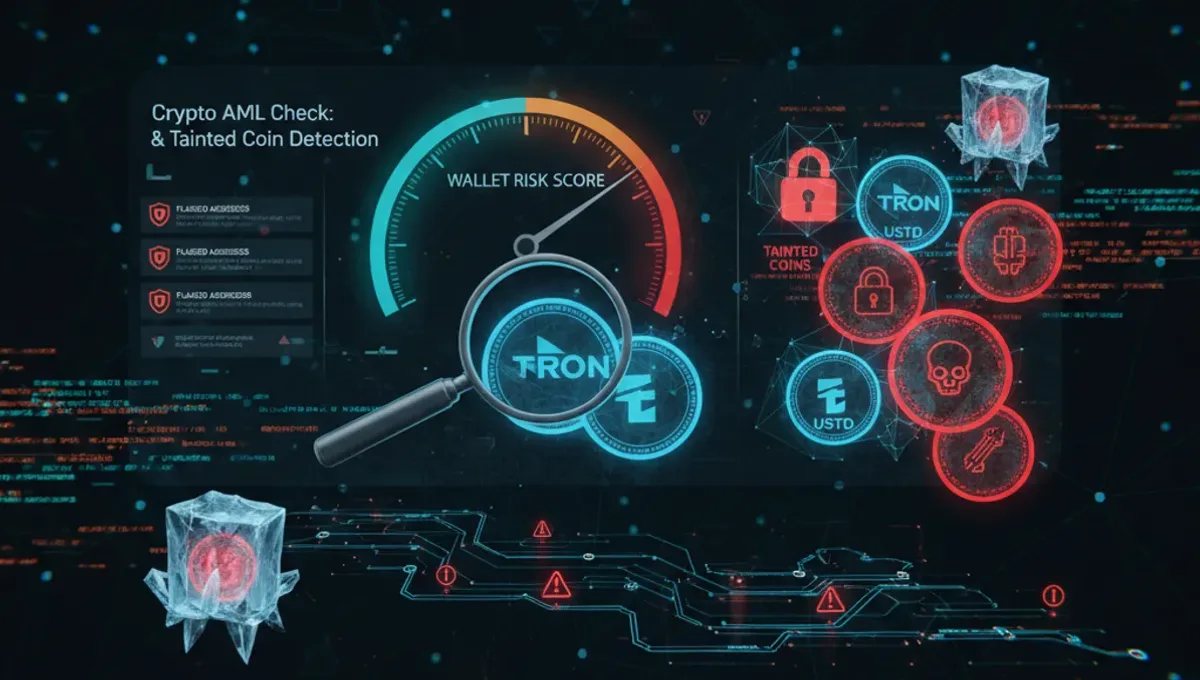
What Is a Crypto AML Check and Why It Matters
An AML check in crypto is a compliance screening tool that analyzes a blockchain address's transaction history and assigns a risk score. AML stands for Anti-Money Laundering—a regulatory framework designed to prevent financial crime. When you perform an AML crypto check online, the system cross-references the address against known risk indicators: darknet market wallets, mixer services, sanctioned entities, gambling platforms, and wallets linked to theft or fraud. The result is a risk score (typically low, medium, or high) that tells you whether the coins are clean or tainted. Exchanges, custodians, and institutional buyers now require AML checks before accepting deposits. Receiving dirty crypto—even unknowingly—can trigger account freezes, transaction reversals, or regulatory investigations. For individuals, running a free AML check before receiving USDT, TRX, or BTC protects you from compliance liability and ensures you're not holding stolen or sanctioned funds.
How AML Risk Scoring Works for Crypto Wallets
An AML risk score is generated by analyzing multiple data points from the blockchain. Here's how the scoring typically works:
1. Transaction history analysis: The system traces all inbound and outbound transactions from the address, looking for patterns that match known risk categories.
2. Darknet exposure: If funds have passed through known darknet market addresses or mixing services, the risk score increases.
3. Sanctions screening: The wallet is checked against international sanctions lists (OFAC, UN, EU) to identify addresses linked to prohibited entities or jurisdictions.
4. Theft and fraud databases: The address is cross-referenced with known stolen fund wallets and scam-associated addresses.
5. Behavioral signals: Rapid fund movements, layering patterns, or connections to high-risk exchanges contribute to the score.
Risk scores are usually categorized as: Low (clean funds, minimal risk), Medium (some exposure to risky services, but not direct involvement), and High (direct darknet, mixer, or sanctions exposure). A medium or high score doesn't automatically mean the funds are illegal—it means they carry compliance risk. Many exchanges will freeze or reject deposits flagged as medium or high risk, regardless of the sender's intent.
How to Check a Crypto Wallet Address for AML Risk
Running an AML check on a TRX, USDT, BTC, or ETH address is straightforward. Follow these steps:
1. Gather the wallet address: Copy the full public address you want to check (e.g., a TRC20 address for USDT on Tron, or a Bitcoin address).
2. Visit a verified AML service: Use one of the trusted AML screening tools listed on our curated AML Services page. These services provide instant risk analysis without requiring registration for basic checks.
3. Paste the address: Enter the wallet address into the search field and initiate the scan.
4. Review the risk report: The service will return a risk score, transaction history summary, and flagged risk categories (if any).
5. Interpret the results: A low score means the wallet is safe to transact with. A medium or high score warrants caution—consider asking the sender for clarification or declining the transaction.
6. Document the check: Keep a record of the AML check result for compliance purposes, especially if you're a business or institutional buyer.
Most verified AML services offer a free tier for basic wallet checks, making it easy to screen addresses before accepting deposits. For high-volume or institutional use, paid tiers provide deeper analytics and API access.
Understanding Risk Score Levels and What They Mean
Risk scores vary by service, but most use a three-tier or numerical scale. Here's what each level typically indicates:
Low Risk (0–30%): The address shows minimal exposure to known high-risk activities. Transactions are consistent with normal wallet behavior. Exchanges and custodians typically accept deposits from low-risk addresses without additional scrutiny.
Medium Risk (30–70%): The address has some connection to risky services—for example, a transaction routed through a mixer or a small amount received from a gambling platform. The funds aren't directly tied to crime, but they carry compliance uncertainty. Many exchanges will flag medium-risk deposits for manual review or require additional KYC documentation.
High Risk (70–100%): The address shows direct exposure to darknet markets, sanctions violations, theft, or significant mixer usage. Exchanges will typically freeze or reject deposits from high-risk addresses. Holding or transacting with high-risk coins can trigger regulatory investigation.
Acceptable thresholds depend on your use case. Individual users should aim for low-risk addresses. Businesses and exchanges often set a medium-risk threshold as their cutoff—anything above that is rejected. If you receive a medium or high-risk score, contact the sender and ask for clarification or request a different address.
What Happens When Your Crypto Is Flagged as Tainted
If an AML check reveals that your coins are tainted—linked to mixers, darknet activity, theft, or sanctions—several consequences can follow:
Exchange freezes: When you attempt to deposit flagged coins to an exchange, the deposit may be held or rejected outright. The exchange's compliance team will investigate the transaction history. If they determine the coins are high-risk, your account may be frozen pending review.
Account bans: Repeated attempts to deposit tainted coins or a single large deposit of flagged funds can result in permanent account closure. Exchanges are required by law to refuse transactions linked to money laundering or sanctions violations.
Frozen USDT and other stablecoins: If your USDT or other stablecoin is flagged, the issuer (e.g., Tether) may freeze the token at the smart contract level, rendering it unusable across all platforms.
Regulatory scrutiny: Holding or transacting with sanctioned funds can expose you to legal liability, especially if you're in a jurisdiction with strict AML enforcement.
What to do: If your coins are flagged, stop attempting to deposit them immediately. Contact the exchange's compliance team and provide documentation of how you acquired the funds. If the coins were received in error or from an unknown source, consider abandoning them. Do not attempt to launder tainted coins through mixers—this compounds the legal risk.
Free vs. Paid AML Crypto Check Services
Free AML checks are available through most verified services, but they come with limitations. Here's what to expect:
Free AML checks: Typically provide a basic risk score and transaction summary. Most free tiers allow 1–5 checks per day without registration. They're sufficient for individuals who occasionally need to screen a wallet before accepting a transfer. Free checks usually cover the major blockchains (Bitcoin, Ethereum, Tron) and stablecoins (USDT, USDC).
Paid AML checks: Offer deeper analytics, including detailed transaction graphs, entity identification, and historical risk tracking. Paid plans are designed for businesses, exchanges, and compliance teams. They often include API access for automated wallet screening, batch processing, and priority support.
Choosing a service: Start with our curated list of verified AML services on the AML Services page. These providers have been vetted for accuracy, compliance with regulatory standards, and data security. Avoid unverified or low-cost services that may provide inaccurate risk scores or sell your data.
When to upgrade: If you're receiving crypto regularly or managing funds for a business, a paid service is worth the investment. The cost is minimal compared to the risk of frozen funds or regulatory penalties.
Best Practices for Avoiding Tainted Coins
Prevention is easier than dealing with frozen funds. Follow these practices to minimize exposure to tainted crypto:
1. Always run an AML check before accepting large transfers: Make it a habit to screen any wallet address before accepting a significant amount of crypto, especially from unknown sources.
2. Request wallet history from senders: Ask where the coins originated. Legitimate senders should be able to provide a clear explanation.
3. Use reputable exchanges and custodians: Withdraw crypto only from well-known, regulated exchanges. Avoid peer-to-peer transfers from unverified sources.
4. Avoid mixers and privacy coins: Do not send your coins through mixing services or receive coins that have been mixed. Mixing is a red flag for compliance teams.
5. Monitor your wallet's risk score over time: Some services allow you to track a wallet's risk score as it evolves. A sudden increase in risk score may indicate incoming tainted funds.
6. Document all checks: Keep records of AML checks you've run, especially for business purposes. This demonstrates due diligence if regulators inquire.
7. Set a personal risk threshold: Decide in advance what risk score level you're willing to accept. For most individuals, low-risk addresses only. For businesses, medium-risk may be acceptable with additional documentation.
By screening wallets proactively, you avoid the complications of frozen accounts, regulatory investigation, and the loss of access to your funds.
Frequently asked questions
Is there a free AML crypto check available?
Yes. Most verified AML services offer free basic checks that reveal a wallet's risk score and transaction summary. Free tiers typically allow 1–5 checks daily without registration. For occasional wallet screening, free checks are sufficient. Paid plans unlock deeper analytics and API access for businesses.
What does a high AML risk score mean for my USDT or BTC?
A high risk score (typically 70–100%) indicates the wallet has direct exposure to darknet markets, mixers, theft, or sanctions violations. Exchanges will likely freeze or reject deposits from high-risk addresses. Holding high-risk coins can trigger regulatory investigation and account bans.
Can I remove a tainted coin flag from my wallet?
No. A coin's transaction history is immutable on the blockchain. Once flagged as tainted, it remains flagged. You cannot clean tainted coins. Your only option is to stop attempting to deposit them and contact the exchange's compliance team if your account is frozen.
How long does an AML crypto check take?
Most AML checks complete instantly—within seconds. The service scans the blockchain address, cross-references it against risk databases, and returns a risk score and summary. No registration or waiting period is required for basic checks on verified services.
Do I need to check every wallet address I receive crypto from?
For large transfers or unknown senders, yes. For small amounts from trusted sources (friends, known businesses), a check is optional but recommended. If you're a business or institutional buyer, check all incoming addresses as part of your compliance process.